A new code that standardizes the public reporting of geothermal energy on the Canadian stock market signals a change in investor confidence in the geothermal energy sector.
Brian Toohey is a Canadian reporting code committee member for the Canadian Geothermal Energy Association who initiated the industry regulation practices applauded by the Toronto Stock Exchange and the Canadian Securities Commission in March 2010.
“The Canadian financial industry all the way down to the average investor has been waiting for something like this,” he said.
Before the code was introduced in January of this year, the public was reluctant to invest in geothermal companies listed on the TSX – the resource industry securities hub in North America – because there was a lack of transparency and understanding about the industry. Prior to now, geothermal investors would have needed to be geology or engineering experts to assess stock values and compare companies. This drove profits down because people didn't know what they were getting into if they put their money into geothermal ventures.
“Right now it's kind of the Wild West of the industry in terms of the fact that one person says P90, P50, one person says this many megawatts, sure we can do this, we can do that...,” said Toohey.
In the oil industry, standardization makes it one of the preferred energy stocks to invest in. A barrel extracted in one part of the country is listed as same as a barrel drilled in another part of the country, something that previously couldn't be measured with geothermal power.
The code makes it easier to analyze geothermal companies' annual and quarterly reports and compare websites like in the oil, gas and mining sectors.
“They want to be able to speak the same language, talk knowledgeably on projects and want to understand the limitations to certain stages of (geothermal) development,” he said.
Now investors are better able to raise money for geothermal companies to get more projects off the ground in Canada, the US and abroad. The hope is that the U.S. will follow suit.
“It would be obviously fantastic if one day the U.S. market was that open to geothermal standardization and offered that sort of treatment to a similar peer geothermal association,” Toohey said.
The code also makes the geothermal industry more environmentally accountable. Although geothermal is by nature a very environmentally-friendly energy resource, companies haven't been uniformly ethical, Toohey said. Projects must now meet the modifying factors set by the code – permission of the government, facilitation with community members, meeting environmental impact standards.
“Beforehand when you get a geologist or an engineer around the table we say, oh well we're pretty confident that it will be this many megawatts subsurface in x place, but no one ever took into consideration social, environmental, first nations issues,” he said,
Already CanGea has seen a marked change.
“We've seen an increase in activity and it's actually been a total buzz around the international community,” said Toohey.
This year it is voluntary for companies to follow the code but next year it will be compulsory for CanGea membership. However, the TSX has yet to make the code a mandatory requirement.
Monday, October 4, 2010

More Graffiti in Deep Cove
The District of North Vancouver reported a “rash of graffiti” in Deep Cove in recent weeks, an area that doesn't usually have a lot of tagging activity.
“It's hitting out in an area we hadn't seen it before,” said Carol Walker of the District bylaw office.
"Graffiti is typically around Pemberton and Marine Drive corridor for us and more so in the city of North Vancouver and the bottom of Lonsdale,” said Walker adding that the extent of graffiti vandalism they have seen in past years in Deep Cove has been the odd post box.
An RCMP-led integrated task force is investigating the situation.
According to Walker, the taggers could be living close to or within the neighbourhoods where the graffiti is found and might be a newcomer to the area. They are also typically a younger age.
“We want to be able to rid graffiti from the North Shore entirely, not just move it around,” said Walker, “Eighty percent of those folks that are doing this sort of damage, it's a precursor to other crime.”
Fines for both graffiti tagging or allowing graffiti to remain on property are $200. But Walker said the bylaw office doesn't like to ticket very often.
“We really want voluntary compliance because we just want people to understand that the faster they remove it off their property the less likely that it's going to return,” she said. Removing graffiti acts as a deterrent. Evidence of this was the Pemberton graffiti that was removed about a month ago and hasn't yet returned.
Walker said the graffiti task force has discussed putting a public art wall around the sea bus area where a lot of graffiti is found. But she said this won't stop graffiti from happening throughout the district.
“From what I understand, you're still going to get these taggers tagging even though you've got these community art walls. It's two different groups of people. The taggers are about the criminal activity and vandalism and of course the artists that just want a space to work their art it doesn't necessarily prevent graffiti from happening where we don't want it to occur,” Walker said.
Walker said of the Deep Cove graffiti incidents: “This is not art. This is staking their territory.”
But this is a common misconception about graffiti taggers, said Adrian Archambault of the Community Policing Centre for Grandview-Woodland in Vancouver. Archambault oversees the RestART program, a Vancouver-based restorative justice project that began a graffiti management initiative with the City of Vancouver to allow graffiti taggers to channel their skills. Graffiti artists work with mentors to design murals on city-approved walls, that has lead to changing public perception around the art form, he said.
“From the criminal perspective graffiti tagging is almost like an addiction. It's not territorial so much as it's a compulsion,” Archambault said, “The way it is perceived is not always the way it was intended.”
Those who suspect graffiti taggers are acting in their neighbourhoods are asked to call 911 to report vandalism. Those who are the victims of graffiti should contact the District to get a 40 per cent off paint voucher.
“It's hitting out in an area we hadn't seen it before,” said Carol Walker of the District bylaw office.
"Graffiti is typically around Pemberton and Marine Drive corridor for us and more so in the city of North Vancouver and the bottom of Lonsdale,” said Walker adding that the extent of graffiti vandalism they have seen in past years in Deep Cove has been the odd post box.
An RCMP-led integrated task force is investigating the situation.
According to Walker, the taggers could be living close to or within the neighbourhoods where the graffiti is found and might be a newcomer to the area. They are also typically a younger age.
“We want to be able to rid graffiti from the North Shore entirely, not just move it around,” said Walker, “Eighty percent of those folks that are doing this sort of damage, it's a precursor to other crime.”
Fines for both graffiti tagging or allowing graffiti to remain on property are $200. But Walker said the bylaw office doesn't like to ticket very often.
“We really want voluntary compliance because we just want people to understand that the faster they remove it off their property the less likely that it's going to return,” she said. Removing graffiti acts as a deterrent. Evidence of this was the Pemberton graffiti that was removed about a month ago and hasn't yet returned.
Walker said the graffiti task force has discussed putting a public art wall around the sea bus area where a lot of graffiti is found. But she said this won't stop graffiti from happening throughout the district.
“From what I understand, you're still going to get these taggers tagging even though you've got these community art walls. It's two different groups of people. The taggers are about the criminal activity and vandalism and of course the artists that just want a space to work their art it doesn't necessarily prevent graffiti from happening where we don't want it to occur,” Walker said.
Walker said of the Deep Cove graffiti incidents: “This is not art. This is staking their territory.”
But this is a common misconception about graffiti taggers, said Adrian Archambault of the Community Policing Centre for Grandview-Woodland in Vancouver. Archambault oversees the RestART program, a Vancouver-based restorative justice project that began a graffiti management initiative with the City of Vancouver to allow graffiti taggers to channel their skills. Graffiti artists work with mentors to design murals on city-approved walls, that has lead to changing public perception around the art form, he said.
“From the criminal perspective graffiti tagging is almost like an addiction. It's not territorial so much as it's a compulsion,” Archambault said, “The way it is perceived is not always the way it was intended.”
Those who suspect graffiti taggers are acting in their neighbourhoods are asked to call 911 to report vandalism. Those who are the victims of graffiti should contact the District to get a 40 per cent off paint voucher.
Wednesday, June 16, 2010
Drum Mama Studios
“I am woman, hear me roar!” These are the words drummer Sandi Millman uses to describe what it is like to participate in a drum circle.
A long-time musician on the Vancouver scene, Millman operates Drum Mama studio out of her Kerrisdale home. It is here she shares her love of rhythm and the healing properties of hand drumming with her students of all ages and levels.
What you’ll take away from Millman’s classes is a sense of empowerment that comes with being fully free to express yourself.
“This is such a wonderful way to connect with each other and we can have so much fun, and it’s not about being a great musician, it’s about enjoying the process,” Millman told the Independent.
Millman isn’t bashful while bashing away on the drums and her infectious energy betrays her South American roots. Originally from Chile, Millman said she thinks what is lacking in Canadian culture is our connection to our bodies. This stifled physicality can be seen in how we respond to music, she suggested.
“When you go to the corner, or there’s a musician on Granville Island, you don’t see people dancing away and totally getting into it,” she said.
“Where I’m from in South America, you see people dancing more. They get into it – they get into the groove. They’re a little more in tune with that energy, with connecting and rhythm, celebrating together, moving and dancing. It’s part of the culture. In our culture, we don’t really express ourselves that way, and I’m all about just bringing back that very organic, natural, primal way through the spirit of the drum,” she said.
To do this, music must be accessible to everyone, she said.
According to Millman, in some cultures, there isn’t one particular word for musician. Everyone is seen as a music maker and relating to the vibration of music is innate to humans.
“In our culture, there’s this idea that music making is for musicians, and a lot of people are left feeling they’re not professional, or they’re not allowed to play or entitled to enjoy music making, and, I think what I do is try to let people know, ‘Hey, wait a minute! We’re all born to make music [and] to make music together.’ It is our birthright to express ourselves with rhythm,” said Millman.
The holistic effects of drumming are manifold, she said. One of these effects is the serenity that inhabits your body, which can be similar to a transcendental meditation exercise or chanting a mantra.
“We’ll repeat the rhythm over and over, and what ends up happening is you feel, in many ways, a brain relaxation or a rest,” she said. “People leave the class feeling rejuvenated and feeling a sense of calm [after having] often come into the class feeling rushed.”
This rushing around manifests itself in an accelerated pulse and, at the start of each class, Millman encourages her students to keep their heart rate steady.
“I try to keep the beat from pushing forward and then, after about five minutes, everybody is relaxed into this beautiful groove together,” she said.
Coming from a classical dance background, Millman approaches drumming kinesthetically, which is obvious when you watch her tiny frame undulate gracefully as she plays. She spent 10 years accompanying modern dance classes at Arts Umbrella before moving onto playing congas at nightclubs around the city. It was when she became a mother that she realized she is most at home when teaching. However, she still manages to balance teaching djembe classes with her love of performing and has taken up the Middle Eastern doumbek as another punctuation on her percussion resumé.
Millman’s belief in the therapeutic aspects of rhythm is evident in her extensive training. She has worked to perfect her art with Cuban and African drum masters, but she has also studied with leading facilitators who use rhythm for personal and health empowerment. This has led her to work with such luminaries as Arthur Hall, grandfather of the Western drum circle, and internationally acclaimed music therapist Christine Stevens, who conducts research on the scientific benefits of drumming.
“Drumming has been such a healing part of my life. It has always been there when I was going through difficult times in my life from a teenager to adult. I want to share that,” Millman said.
There’s no beating around the bush when it comes to the reverence other cultures have for the drum, she stressed. In Africa, the drummer is the high priest. In some tribes, a drummer is equivalent to a psychologist. A book published by Mamady Keita of the Malinke people in West Africa describes which drum beats cure different body ailments and psychological disorders. Millman incorporates these teachings with her university degree in psychology and counseling to better coach students who discover a surge of strong feelings when they play.
“I’m very comfortable with giving space for my students to have their emotional experience to let it be what it is. For some people, I would recommend a private class if I know they’re grieving or having a hard time and then, that way, if something does come up, it’s totally comfortable for them,” she said.
Visit www.drummama.com or contact Millman at 604-873-9495 or sandi@drummama.com.
A long-time musician on the Vancouver scene, Millman operates Drum Mama studio out of her Kerrisdale home. It is here she shares her love of rhythm and the healing properties of hand drumming with her students of all ages and levels.
What you’ll take away from Millman’s classes is a sense of empowerment that comes with being fully free to express yourself.
“This is such a wonderful way to connect with each other and we can have so much fun, and it’s not about being a great musician, it’s about enjoying the process,” Millman told the Independent.
Millman isn’t bashful while bashing away on the drums and her infectious energy betrays her South American roots. Originally from Chile, Millman said she thinks what is lacking in Canadian culture is our connection to our bodies. This stifled physicality can be seen in how we respond to music, she suggested.
“When you go to the corner, or there’s a musician on Granville Island, you don’t see people dancing away and totally getting into it,” she said.
“Where I’m from in South America, you see people dancing more. They get into it – they get into the groove. They’re a little more in tune with that energy, with connecting and rhythm, celebrating together, moving and dancing. It’s part of the culture. In our culture, we don’t really express ourselves that way, and I’m all about just bringing back that very organic, natural, primal way through the spirit of the drum,” she said.
To do this, music must be accessible to everyone, she said.
According to Millman, in some cultures, there isn’t one particular word for musician. Everyone is seen as a music maker and relating to the vibration of music is innate to humans.
“In our culture, there’s this idea that music making is for musicians, and a lot of people are left feeling they’re not professional, or they’re not allowed to play or entitled to enjoy music making, and, I think what I do is try to let people know, ‘Hey, wait a minute! We’re all born to make music [and] to make music together.’ It is our birthright to express ourselves with rhythm,” said Millman.
The holistic effects of drumming are manifold, she said. One of these effects is the serenity that inhabits your body, which can be similar to a transcendental meditation exercise or chanting a mantra.
“We’ll repeat the rhythm over and over, and what ends up happening is you feel, in many ways, a brain relaxation or a rest,” she said. “People leave the class feeling rejuvenated and feeling a sense of calm [after having] often come into the class feeling rushed.”
This rushing around manifests itself in an accelerated pulse and, at the start of each class, Millman encourages her students to keep their heart rate steady.
“I try to keep the beat from pushing forward and then, after about five minutes, everybody is relaxed into this beautiful groove together,” she said.
Coming from a classical dance background, Millman approaches drumming kinesthetically, which is obvious when you watch her tiny frame undulate gracefully as she plays. She spent 10 years accompanying modern dance classes at Arts Umbrella before moving onto playing congas at nightclubs around the city. It was when she became a mother that she realized she is most at home when teaching. However, she still manages to balance teaching djembe classes with her love of performing and has taken up the Middle Eastern doumbek as another punctuation on her percussion resumé.
Millman’s belief in the therapeutic aspects of rhythm is evident in her extensive training. She has worked to perfect her art with Cuban and African drum masters, but she has also studied with leading facilitators who use rhythm for personal and health empowerment. This has led her to work with such luminaries as Arthur Hall, grandfather of the Western drum circle, and internationally acclaimed music therapist Christine Stevens, who conducts research on the scientific benefits of drumming.
“Drumming has been such a healing part of my life. It has always been there when I was going through difficult times in my life from a teenager to adult. I want to share that,” Millman said.
There’s no beating around the bush when it comes to the reverence other cultures have for the drum, she stressed. In Africa, the drummer is the high priest. In some tribes, a drummer is equivalent to a psychologist. A book published by Mamady Keita of the Malinke people in West Africa describes which drum beats cure different body ailments and psychological disorders. Millman incorporates these teachings with her university degree in psychology and counseling to better coach students who discover a surge of strong feelings when they play.
“I’m very comfortable with giving space for my students to have their emotional experience to let it be what it is. For some people, I would recommend a private class if I know they’re grieving or having a hard time and then, that way, if something does come up, it’s totally comfortable for them,” she said.
Visit www.drummama.com or contact Millman at 604-873-9495 or sandi@drummama.com.
Fiesta Fever for Vancouver
 Entrepreneur Chen Lizra is once again pairing up with restaurateur Mona Chaaban of Mona’s Fine Lebanese Cuisine to bring back spicy nights of dance and Middle Eastern food to Vancouver.
The duo return with the all-ages celebration Arab Latin Fiesta, offering a cultural fusion unlike any other in the city. The first event of the season held on May 14 was packed, a sign that the event is filling a void in the city, said the Israeli-born Lizra. The two had hosted the event for three years before going on hiatus in 2007, when Lizra returned to business school and subsequently launched Latidos Productions, her Cuban dance business.
“It’s not just a coincidence that, after [the] three years we haven’t done them, that they were packed again and people said, ‘Wow, we’re coming back for the next one.’ There is something very magical about the event,” Lizra told the Independent.
Lizra’s goal is to keep the Arab Latin Fiesta nights going so that people can have an experience of cultural immersion that is generally only found in larger metropolitans like New York.
“It’s very hard to find, in Vancouver, nights where you actually enter a culture the way that culture is in its own country. There are maybe two or three cultures where you can do that but there’s a lot of cultures where you cannot,” she said, citing Latin and Arab celebrations as being particularly underrepresented in Vancouver.
Lizra and Chaaban’s fiesta features a set menu dinner, performances and dancing, as well as a hookah smoking room, all at Mona’s restaurant downtown Vancouver on Hornby Street.
When conceptualizing the evening, the two women created guidelines to help those in attendance understand the cultural setting and to encourage them to find their place within it.
“We create certain rules – not to be rude, but to allow for those cultures to exist the way they are and allow people to come into them. The majority of people coming are basically people from these cultures and they [naturally] form that kind of attitude.”
The atmosphere Lizra works hard to maintain is intergenerational and participatory, one in which everyone gets up to dance and join in the fun that typically lasts until the wee hours.
“It’s all about love, it’s a little more aggressive, [but] it’s warm, it’s family-oriented; you’ve got kids running around. You see grandma get up and dance with the belly dancer. It feels like you’re in the Middle East. Mona is an incredible cook and she just brings Lebanon to you,” raved Lizra.
The Arab and Latin cultures compliment each other because of their similar dance styles, suggested Lizra, whose Vancouver-based Latidos Productions offers courses in Latin dance, as well as vacation dance tours to Cuba.
“You’ve got the music from all these cultures mixed and people just love it, because people who love Latin dance love to shake it Arabic style and vice versa,” she said.
The next step for Lizra and Chaaban is to incorporate sponsorship so that they can make the event even bigger and support bringing in more dancers from outside the city.
“I think Vancouver is still limited with what we have here to work with and after awhile we’re going to run out of people we can book without repeating ourselves. It’s also fresh and interesting when people say, ‘Wow, we haven’t seen that,’” said Lizra.
Finding Cuban dance instructors for her academy is another challenge Lizra faces, as there are only a handful of professional Cuban dancers living in Canada. She travels to Cuba to train with professional dancers and then brings back what she’s learned to Vancouver. She has designed programs in reggaeton (Cuban hip hop), salsa, rumba, son, cha-cha-chá, mambo and rueda. Through the different dance styles, Lizra imparts the arts of flirtation, seduction and feeling sexy – things, she said, that get lost in North America.
 “Something happens to you when you’re in Cuba where, a man or a woman, it doesn’t matter, you feel completely sexy and attractive because people come on to you all the time and they do it in such a sweet way that you feel gorgeous and that feels good. We just want to feel like that every day.” In North America, Lizra added, these same behaviors can end up being labeled “sexual harassment.”
Lizra fell in love with what she calls the allure of Cuba’s mesmerizing and energetic life force even before she had ever visited the country. When she finally did visit, she found many things that reminded her of her native Israel, from its core socialist values to the afternoon siesta.
Lizra’s Cuba was something she wanted to share beyond what she was able to translate from her regular visits there. This desire led to her facilitating small, two-week tours to the country to enrich people’s impressions beyond guidebook recommendations and popular tourist destinations. The next dance tour of Havana, which has room for seven travelers, is from July 8 to 22.
“A student who has been taking classes with me for about a year just went to Cuba and, as soon as she came back, she was ‘on’ – sexually. She was full of energy and life and she said, ‘I want more of this, bring it on,’” Lizra shared.
In addition to running her business, Lizra is branching out to reach a wider audience with a television series in development about dance around the world. Another idea in the works is a book, called Seducing Your Way to Happiness, that she plans to write after the TV show takes off.
“I think that at this point of my life I have something to say. I think that as you go through the years and you experience life and different cultures something clicks,” she said.
The next Arab Latin Fiesta night is June 18. For information, visit latidosproductions.com.
Monday, May 31, 2010
Exotic Ice cream
A sommelier of frozen cream, a barista of sorbet, Vince Misceo of La Casa Gelato will scoop you off your feet with his 218 flavours of handmade ice cream. His shop is a bright pink eyesore stationed in the most unlikely of places - the industrial section of Vancouver, blocks away from the Downtown Eastside. But for those with a hankering for an exotic sugar fix, the store is a destination no matter the distance. Tourists from Hong Kong will stop by to order 5 litres of durian gelato to take on their flights back as a souvenir. Australians can feel at home with Vegemite ice cream. The Persian community empties the store with buckets of akbar mashti – a mixture of saffron, rosewater and pistachio. For the health nut indulging in guilty pleasures there is wild fennel and dandelion root. At the moment he and his children – true to the Italian culinary legacy of a family recipe passed through the generations – are working on Filipino garju, a fish dish served with green mango.
“I come up with things that never existed before but then sometimes you get customers in from whatever place they're coming from and the first thing they say is, 'Misceo, you've got everything but you don't have what I have in my country,'” he says.
He then makes it his saccharine mission to come up with a taste that parallels what his customers are looking for.
The recipes are simple – cream, eggs, white sugar a bit of lemon to sharpen the taste other.
“I can do it, you can do it, anybody can do it,” he claims.
But beyond this, Misceo is as secret as Willy Wonky about what goes on in his workshop behind the store. When Martha Stewart filmed his show for The Learning Channel she was barred from seeing where the magic happens. For a while, even his wife wasn't allowed a peek.
The inventions are made with real fruit, no extracts or colouring. They adjust the sugar levels depending on which fruit they are using in the base. If the concoction is too sweet, it won't freeze, he explains. Some flavours like the highly sought after cherimoya is only available when in season.
When Misceo started the business in 1982, he used his children as guinea pigs. “I would look at their faces to see whether it was good or bad or otherwise,” he said.
While some flavours don't make it to the shelf, Misceo gambles with flavours that pass the initial taste test of his kids. Then it goes to the store where six or seven employees hustle like stock brokers behind the counter scooping small spoons of curry and garlic for curious and adventurous customers to palette.
“You come and you try it if you like it we'll keep it on the shelf and if you don't we put it aside,” he said.
Misceo is equally as secretive about which flavour he has a soft spot for.
“People say 'What's your favourite' and I say, 'What's my favourite and what's your favourite are two different things,'” he said.
You'll just have to have a lick for yourself. Discretionary advice: allow ample time for determining whether a scoop of Guiness would best accompany a scoop of wasabi or basil.
“I come up with things that never existed before but then sometimes you get customers in from whatever place they're coming from and the first thing they say is, 'Misceo, you've got everything but you don't have what I have in my country,'” he says.
He then makes it his saccharine mission to come up with a taste that parallels what his customers are looking for.
The recipes are simple – cream, eggs, white sugar a bit of lemon to sharpen the taste other.
“I can do it, you can do it, anybody can do it,” he claims.
But beyond this, Misceo is as secret as Willy Wonky about what goes on in his workshop behind the store. When Martha Stewart filmed his show for The Learning Channel she was barred from seeing where the magic happens. For a while, even his wife wasn't allowed a peek.
The inventions are made with real fruit, no extracts or colouring. They adjust the sugar levels depending on which fruit they are using in the base. If the concoction is too sweet, it won't freeze, he explains. Some flavours like the highly sought after cherimoya is only available when in season.
When Misceo started the business in 1982, he used his children as guinea pigs. “I would look at their faces to see whether it was good or bad or otherwise,” he said.
While some flavours don't make it to the shelf, Misceo gambles with flavours that pass the initial taste test of his kids. Then it goes to the store where six or seven employees hustle like stock brokers behind the counter scooping small spoons of curry and garlic for curious and adventurous customers to palette.
“You come and you try it if you like it we'll keep it on the shelf and if you don't we put it aside,” he said.
Misceo is equally as secretive about which flavour he has a soft spot for.
“People say 'What's your favourite' and I say, 'What's my favourite and what's your favourite are two different things,'” he said.
You'll just have to have a lick for yourself. Discretionary advice: allow ample time for determining whether a scoop of Guiness would best accompany a scoop of wasabi or basil.
Wednesday, May 26, 2010
Faery Style Fashion
If you want to make a tutu you've got to grow a ruffle patch.

This is according to designer Kelsey Faery who—aside from being living proof that winged creatures of the forest exist—is widely known as “the tutu girl”. Kelsey's signature pieces—her circus-like tailcoats called Faery Tails, tiny top hats, ruffle leg-warmers and tutus—are becoming increasingly popular wardrobe staples for those travelling the West Coast summer festival circuit.
“Sewing” the seeds of creativity with a colour palette that puts a rainbow to shame, Kelsey is a DIY lifesaver of fashion, throwing a multi-coloured lifebuoy to the non-descript jeans and t-shirt automatons tangled up in the John-Doe-threads of mainstream trends.
She lives up to her name with her hue-phoric philosophy that life is more fun when you're rolling along with the colour wheel.
“The way I think of faeries are people who brighten people's day and lighten things up. They open people’s eyes to how much fun and good things there are in life.”
Her one-size-fits-all credo: the world needs more tutus.
Her mission is not a superficial one; wearing her costumes will lift you out of a funk and give the world a much needed rainbow paint job. Her productions are enough to make the colour-blind see. She even breaks down the barriers of colour discrimination and is careful not to express a favourite as it might offend the other colours.
 Coming literally out of the woodwork—her first career was as a woodworker, she sold her first plywood creations to her parent's friends at 12—she started crafting while recovering from cutting part of her left ring finger off with a table saw while making a log picture frame when she was tired. Seven years ago, she made her first hat for the legendary 40,000-person Burning Man Festival in the Nevada desert. It was a basic pyramid structure covered with silk flowers and leaves. However, what launched her to underground circles of fame were her tutus that began as simple short affairs made out of a bit of crinoline and lace. She later developed longer elaborate tutus out of satin, lace, and organza which she named “Trutus” in homage to Judah Tru, the first boy she met who wore her tutus. She and six friends wandered around Burning Man camps in tutus for what became a regular tradition of celebrating Tutu Tuesdays. The celebration later became tea parties in Whistler and the legend grew from there.
It was shortly after her first “burn” that she hooked up with the Funginears, a trip hop band that wanted to borrow tutus from her collection for a beatboxing puppet show.
“They came up to Whistler to visit me [from the Sunshine Coast] and they saw my tutu collection. Not the ones I'd made but the ones I collected and they said, ‘I need to buy that one that one that one and that one’ and I was like, ‘Well, that's my tutu collection I can't sell them,’ and they were like, ‘You need to make tutus’.”
The head Funginear bought one of her costumes for his girlfriend and with the $600 she earned from the deal she planted what she affectionately refers to as her first ruffle patch.
Since 2007, Kelsey has been spending two months out of the year in a bungalow in Bali, outsourcing her line to a team of ruffle faeries who rustle up ruffles fast enough to feed her growing clientele. She then follows her shipping container back to North America where she weaves her way up and down the Canadian and American coastline from May to September. This year she'll trade in ski season on Whistler Mountain for her native Australia where she'll sell her “wears” on the circuit there , before making a stopover in Portugal for BOOMFest.
She uses recycled fabric, satin, lace and organza but the secret success of her ingredients is in the alchemy of how it all comes together: she adds time to make it timeless, a splash of majik dust, and lots of love.
“People look my work and say, ‘This is the most awesome thing I've ever seen. I've never seen so many ruffles.’ When people actually put them on and start moving around, it sort of swooshes people fall in love with it. It's pretty amazing. People are pretty awestruck. I think people don't realize that things like this can be created. They just expect clothing to be your everyday jeans and t-shirt and when they see something different that they can actually wear they are like, ‘I need some of this’.”
Kelsey insists that everyday wear should be a costume, that one doesn't need an excuse for over-the-top creative expression and shouldn't be shy about standing out.
“You could take that approach and say, ‘Oh you should wear it when you're out dancing on New Years' Eve or for Halloween,’ but what I say is, ‘Oh my sister has this tailcoat and she wears it to the grocery store and you should wear costume every day. Wear costume for no reason. If your feeling a bit glum, throw a tutu on and it'll give you a bit of juice for the day’.”

If this sounds opaque, one needs only to visit their studio—The Creation Station—at the Function Junction, Whistler's industrial warehouse park. She also welcomes those seeking creative asylum. Established seven years ago, Kelsey and her former partner, painter Chili Tom, moved to Whistler after leaving their basement studio, The Kitkat Ranch in Pemberton. Each wall in The Creation Station is painted a different colour and when you cast your eyes toward the ceiling of the 1500-square-foot warehouse you see nothing but the underside of tutus, suspended like man-made puffy sunset clouds.
Similar to how some might imagine the North Pole pre-Christmas, The Creation Station is a way for Kelsey to encourage people to craft.
“I guess what The Creation Station was about was having a place where people can come and make things and have someone there to inspire them and help them along with their projects.”
Not caught up in the tight-knit folds of the fashion elite, she is happy to go it alone, gladly stitching her unique style for a devout patchwork of followers without recognition.
“To tell you the truth I don't really aspire to be like any other designers. I admire a lot of the really amazing catwalk work where it's all really over-the-top elaborate pieces, but I really just enjoy doing my own work and I'm kind of already living my ideal life: people come to me with a chunk of money and say, ‘Make me something beautiful in this colour,’ and I do.”
Just as a faery would do.

This is according to designer Kelsey Faery who—aside from being living proof that winged creatures of the forest exist—is widely known as “the tutu girl”. Kelsey's signature pieces—her circus-like tailcoats called Faery Tails, tiny top hats, ruffle leg-warmers and tutus—are becoming increasingly popular wardrobe staples for those travelling the West Coast summer festival circuit.
“Sewing” the seeds of creativity with a colour palette that puts a rainbow to shame, Kelsey is a DIY lifesaver of fashion, throwing a multi-coloured lifebuoy to the non-descript jeans and t-shirt automatons tangled up in the John-Doe-threads of mainstream trends.
She lives up to her name with her hue-phoric philosophy that life is more fun when you're rolling along with the colour wheel.
“The way I think of faeries are people who brighten people's day and lighten things up. They open people’s eyes to how much fun and good things there are in life.”
Her one-size-fits-all credo: the world needs more tutus.
Her mission is not a superficial one; wearing her costumes will lift you out of a funk and give the world a much needed rainbow paint job. Her productions are enough to make the colour-blind see. She even breaks down the barriers of colour discrimination and is careful not to express a favourite as it might offend the other colours.
 Coming literally out of the woodwork—her first career was as a woodworker, she sold her first plywood creations to her parent's friends at 12—she started crafting while recovering from cutting part of her left ring finger off with a table saw while making a log picture frame when she was tired. Seven years ago, she made her first hat for the legendary 40,000-person Burning Man Festival in the Nevada desert. It was a basic pyramid structure covered with silk flowers and leaves. However, what launched her to underground circles of fame were her tutus that began as simple short affairs made out of a bit of crinoline and lace. She later developed longer elaborate tutus out of satin, lace, and organza which she named “Trutus” in homage to Judah Tru, the first boy she met who wore her tutus. She and six friends wandered around Burning Man camps in tutus for what became a regular tradition of celebrating Tutu Tuesdays. The celebration later became tea parties in Whistler and the legend grew from there.
 It was shortly after her first “burn” that she hooked up with the Funginears, a trip hop band that wanted to borrow tutus from her collection for a beatboxing puppet show.
“They came up to Whistler to visit me [from the Sunshine Coast] and they saw my tutu collection. Not the ones I'd made but the ones I collected and they said, ‘I need to buy that one that one that one and that one’ and I was like, ‘Well, that's my tutu collection I can't sell them,’ and they were like, ‘You need to make tutus’.”
The head Funginear bought one of her costumes for his girlfriend and with the $600 she earned from the deal she planted what she affectionately refers to as her first ruffle patch.
Since 2007, Kelsey has been spending two months out of the year in a bungalow in Bali, outsourcing her line to a team of ruffle faeries who rustle up ruffles fast enough to feed her growing clientele. She then follows her shipping container back to North America where she weaves her way up and down the Canadian and American coastline from May to September. This year she'll trade in ski season on Whistler Mountain for her native Australia where she'll sell her “wears” on the circuit there , before making a stopover in Portugal for BOOMFest.
She uses recycled fabric, satin, lace and organza but the secret success of her ingredients is in the alchemy of how it all comes together: she adds time to make it timeless, a splash of majik dust, and lots of love.
“People look my work and say, ‘This is the most awesome thing I've ever seen. I've never seen so many ruffles.’ When people actually put them on and start moving around, it sort of swooshes people fall in love with it. It's pretty amazing. People are pretty awestruck. I think people don't realize that things like this can be created. They just expect clothing to be your everyday jeans and t-shirt and when they see something different that they can actually wear they are like, ‘I need some of this’.”
Kelsey insists that everyday wear should be a costume, that one doesn't need an excuse for over-the-top creative expression and shouldn't be shy about standing out.
“You could take that approach and say, ‘Oh you should wear it when you're out dancing on New Years' Eve or for Halloween,’ but what I say is, ‘Oh my sister has this tailcoat and she wears it to the grocery store and you should wear costume every day. Wear costume for no reason. If your feeling a bit glum, throw a tutu on and it'll give you a bit of juice for the day’.”

If this sounds opaque, one needs only to visit their studio—The Creation Station—at the Function Junction, Whistler's industrial warehouse park. She also welcomes those seeking creative asylum. Established seven years ago, Kelsey and her former partner, painter Chili Tom, moved to Whistler after leaving their basement studio, The Kitkat Ranch in Pemberton. Each wall in The Creation Station is painted a different colour and when you cast your eyes toward the ceiling of the 1500-square-foot warehouse you see nothing but the underside of tutus, suspended like man-made puffy sunset clouds.
Similar to how some might imagine the North Pole pre-Christmas, The Creation Station is a way for Kelsey to encourage people to craft.
“I guess what The Creation Station was about was having a place where people can come and make things and have someone there to inspire them and help them along with their projects.”
Not caught up in the tight-knit folds of the fashion elite, she is happy to go it alone, gladly stitching her unique style for a devout patchwork of followers without recognition.
“To tell you the truth I don't really aspire to be like any other designers. I admire a lot of the really amazing catwalk work where it's all really over-the-top elaborate pieces, but I really just enjoy doing my own work and I'm kind of already living my ideal life: people come to me with a chunk of money and say, ‘Make me something beautiful in this colour,’ and I do.”
Just as a faery would do.
Monday, May 10, 2010
Gretchen Elsner: Avant Garb
Fashion victims, read no further.
Wearable art appreciators who would lay down their life for a custom-made, three-piece suit made out of turn-of-the-century potato flour sacks salvaged from an old barn, meet your maker: Gretchen Elsner.

Elsner is a horse whisperer of fabric, letting it tell her what it wants to be made into. In the case of the flour sack suit, the burlap said, “Yippee! I thought I was going to rot.”
She rescued the sacks from a farmer who was cleaning out his barn and didn't know what to do with them.
When she isn't commissioned, to make an article of clothing, her journey from concocted idea to first stitch to wearer is kismet. She described it as being compelled to make clothing for people she is fated to meet, adopting an 'if you build it, they will come' philosophy that has carried her professionally for the ten years her business has blossomed.
Call it fate that Elsner, who is originally from Georgia, was working at Simon Fraser University in Vancouver when she was denied status as a permanent resident. The reason: she moved in with her goddaughter's mother for a spell to help out after the dad split and mom had to go back to work. As a result, she couldn't provide adequate rental receipts proving she had been in Canada for three years.
She was forced give up her job making garment installations that were shown all over the world to move back to Georgia and work as a waitress at the roadside diner chain The Waffle House to support herself and her 10-year-old son, Julian.
Read on to find out more reasons to hate bureaucracy. Kafka could have based The Castle on Elsner for an equally exasperating read.
Elsner's path didn't involve studying at a prestigious art school or making inroads into the fashion world. However, her success story is still hunger-driven. Literally.
“It was after I was bitten by a rabbid cat...” (Only a bad excuse for not having your homework done could sound more implausible).
“It was in the first trimester in my pregnancy. The animal had come into the place we were living, which was just a dump at the time, so I sued the landlady and lost the lawsuit. So then I had all these exorbitant medical expenses related to high frequency ultrasounds and vaccinations because the American medical system is really screwy and it was just considered an extraneous condition so I had this massive debt to pay off. So that's when I started making clothes for commercial sale.”
Where is Karl Lagerfeld when you need an audience?
Elsner, whose most recent expedition to find reclaimed fabric included fishing soiled satin out of the trash at the Habitat for Humanity store, has gone from rags to riches and back again. She is currently living in a trailer which she designed and built from the ground up, teaching herself how to work with rigid steel.
She has also made clothes out of old sails, Tyvek housing wrap made by DuPont and the metal screens used to make soy milk. She has put together costumes for Full Circle, a West Coast native performance group that turns cedar bark into fabric in the traditional way of First Nations peoples. With a soft spot for antiquity, she has made restoration pieces out of hand-crocheted lace.

Perhaps her most signature pieces are her elaborate, mixed media pop-up books. One pop-up book is called The Banana Slug story. When Elsner was first hiking in British Columbia, she had never seen a banana slug, native to the Pacific coast rainforest. She was so taken by the creature, she decided to write a tale about its quest to find love. Fifteen inches and seven pages including a fold out Victoria peep show, the books are lovingly created not for children, but rather, for the slumbering adult imagination.
“This banana slug gets picks up by a starling and taken out of the woods and into the city and so this banana slug finds himself pursued by all these common variety slugs. So it's moving slowly toward a spigot and it thinks it's moving toward another banana slug then it sees it's own reflection and gets so excited it fertilizes itself.”

The pop-up books is a carryover from Elsner's beginnings as a playwright when she won a Scholastic literary award at 16. She produced another play with the cash prize and continued to put on shows, including a radio play for National Public Radio, all the while designing the set and the costumes. It was when she became a mother that she turned her efforts exclusively to making costumes. She also performed in her husband's band when they went on tour, wedging her rack in with band gear and setting up on the sidewalk at farmers markets along the way.
“When my son was just born he was a really good sleeper and when my husband was at work he'd go to bed at six and then my husband would get home at nine so I had about three hours every night and I was making costumes for performing,” she said.
All at the ripe old age of 20.
Humble about her career, Elsner's approach to clothing is “we've all got to wear it.” Where the fashion industry falls short of making bold cultural statements is that it is too image-conscious.
“Fashion to me has a lot to do with allowing easy communication between people. Two men in a business suit meet each other and, aside from just a handshake and a smile, there's already a kind of instant rapport and I think that a lot of times fashion helps facilitate easy communication. It puts a lot more onus on a person to dress themselves appropriately or in a particular style so it makes it easy for someone to come up and interact with you,” she said.
Wearable art, on the other hand, makes a comment about the human condition and creates an environment that allows for unique encounters.
“To make something that is obviously a piece of artwork, in the best of cases it will really inspire someone to stop and have an experience that is outside their normal everyday awareness. Fashion doesn't necessarily try to do that. There are other agendas in mind when you're creating a collection of clothing where societal expectations take precedent over individual expression,” she said.
Rather than follow fads or create passing trends, Elsner assembles timeless clothes that people hold onto and hand down to future generations.
“A piece of clothing doesn't last over time unless it is really cared for,” she said, “To meet people who really enjoy something that I've made and inspires them to take care of it helps me know that the things I'm doing will last beyond my lifetime and maybe continue to provide information and culture and sustenance for people longer than I can imagine.”
And what she can imagine goes a long way.
Wearable art appreciators who would lay down their life for a custom-made, three-piece suit made out of turn-of-the-century potato flour sacks salvaged from an old barn, meet your maker: Gretchen Elsner.

Elsner is a horse whisperer of fabric, letting it tell her what it wants to be made into. In the case of the flour sack suit, the burlap said, “Yippee! I thought I was going to rot.”
She rescued the sacks from a farmer who was cleaning out his barn and didn't know what to do with them.
When she isn't commissioned, to make an article of clothing, her journey from concocted idea to first stitch to wearer is kismet. She described it as being compelled to make clothing for people she is fated to meet, adopting an 'if you build it, they will come' philosophy that has carried her professionally for the ten years her business has blossomed.
Call it fate that Elsner, who is originally from Georgia, was working at Simon Fraser University in Vancouver when she was denied status as a permanent resident. The reason: she moved in with her goddaughter's mother for a spell to help out after the dad split and mom had to go back to work. As a result, she couldn't provide adequate rental receipts proving she had been in Canada for three years.
She was forced give up her job making garment installations that were shown all over the world to move back to Georgia and work as a waitress at the roadside diner chain The Waffle House to support herself and her 10-year-old son, Julian.
Read on to find out more reasons to hate bureaucracy. Kafka could have based The Castle on Elsner for an equally exasperating read.
Elsner's path didn't involve studying at a prestigious art school or making inroads into the fashion world. However, her success story is still hunger-driven. Literally.
“It was after I was bitten by a rabbid cat...” (Only a bad excuse for not having your homework done could sound more implausible).
“It was in the first trimester in my pregnancy. The animal had come into the place we were living, which was just a dump at the time, so I sued the landlady and lost the lawsuit. So then I had all these exorbitant medical expenses related to high frequency ultrasounds and vaccinations because the American medical system is really screwy and it was just considered an extraneous condition so I had this massive debt to pay off. So that's when I started making clothes for commercial sale.”
Where is Karl Lagerfeld when you need an audience?
Elsner, whose most recent expedition to find reclaimed fabric included fishing soiled satin out of the trash at the Habitat for Humanity store, has gone from rags to riches and back again. She is currently living in a trailer which she designed and built from the ground up, teaching herself how to work with rigid steel.
She has also made clothes out of old sails, Tyvek housing wrap made by DuPont and the metal screens used to make soy milk. She has put together costumes for Full Circle, a West Coast native performance group that turns cedar bark into fabric in the traditional way of First Nations peoples. With a soft spot for antiquity, she has made restoration pieces out of hand-crocheted lace.

Perhaps her most signature pieces are her elaborate, mixed media pop-up books. One pop-up book is called The Banana Slug story. When Elsner was first hiking in British Columbia, she had never seen a banana slug, native to the Pacific coast rainforest. She was so taken by the creature, she decided to write a tale about its quest to find love. Fifteen inches and seven pages including a fold out Victoria peep show, the books are lovingly created not for children, but rather, for the slumbering adult imagination.
“This banana slug gets picks up by a starling and taken out of the woods and into the city and so this banana slug finds himself pursued by all these common variety slugs. So it's moving slowly toward a spigot and it thinks it's moving toward another banana slug then it sees it's own reflection and gets so excited it fertilizes itself.”
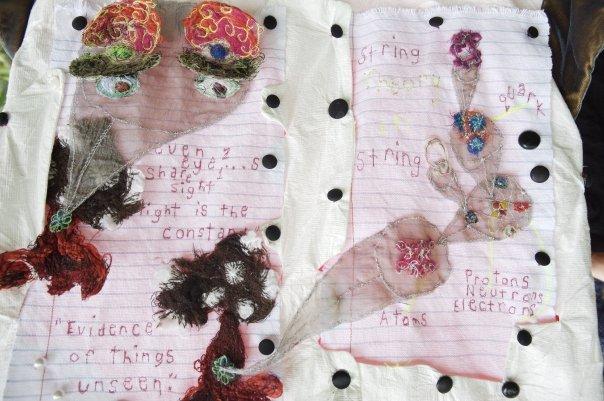
The pop-up books is a carryover from Elsner's beginnings as a playwright when she won a Scholastic literary award at 16. She produced another play with the cash prize and continued to put on shows, including a radio play for National Public Radio, all the while designing the set and the costumes. It was when she became a mother that she turned her efforts exclusively to making costumes. She also performed in her husband's band when they went on tour, wedging her rack in with band gear and setting up on the sidewalk at farmers markets along the way.
“When my son was just born he was a really good sleeper and when my husband was at work he'd go to bed at six and then my husband would get home at nine so I had about three hours every night and I was making costumes for performing,” she said.
All at the ripe old age of 20.
Humble about her career, Elsner's approach to clothing is “we've all got to wear it.” Where the fashion industry falls short of making bold cultural statements is that it is too image-conscious.
“Fashion to me has a lot to do with allowing easy communication between people. Two men in a business suit meet each other and, aside from just a handshake and a smile, there's already a kind of instant rapport and I think that a lot of times fashion helps facilitate easy communication. It puts a lot more onus on a person to dress themselves appropriately or in a particular style so it makes it easy for someone to come up and interact with you,” she said.
Wearable art, on the other hand, makes a comment about the human condition and creates an environment that allows for unique encounters.
“To make something that is obviously a piece of artwork, in the best of cases it will really inspire someone to stop and have an experience that is outside their normal everyday awareness. Fashion doesn't necessarily try to do that. There are other agendas in mind when you're creating a collection of clothing where societal expectations take precedent over individual expression,” she said.
Rather than follow fads or create passing trends, Elsner assembles timeless clothes that people hold onto and hand down to future generations.
“A piece of clothing doesn't last over time unless it is really cared for,” she said, “To meet people who really enjoy something that I've made and inspires them to take care of it helps me know that the things I'm doing will last beyond my lifetime and maybe continue to provide information and culture and sustenance for people longer than I can imagine.”
And what she can imagine goes a long way.
Subscribe to:
Comments (Atom)